
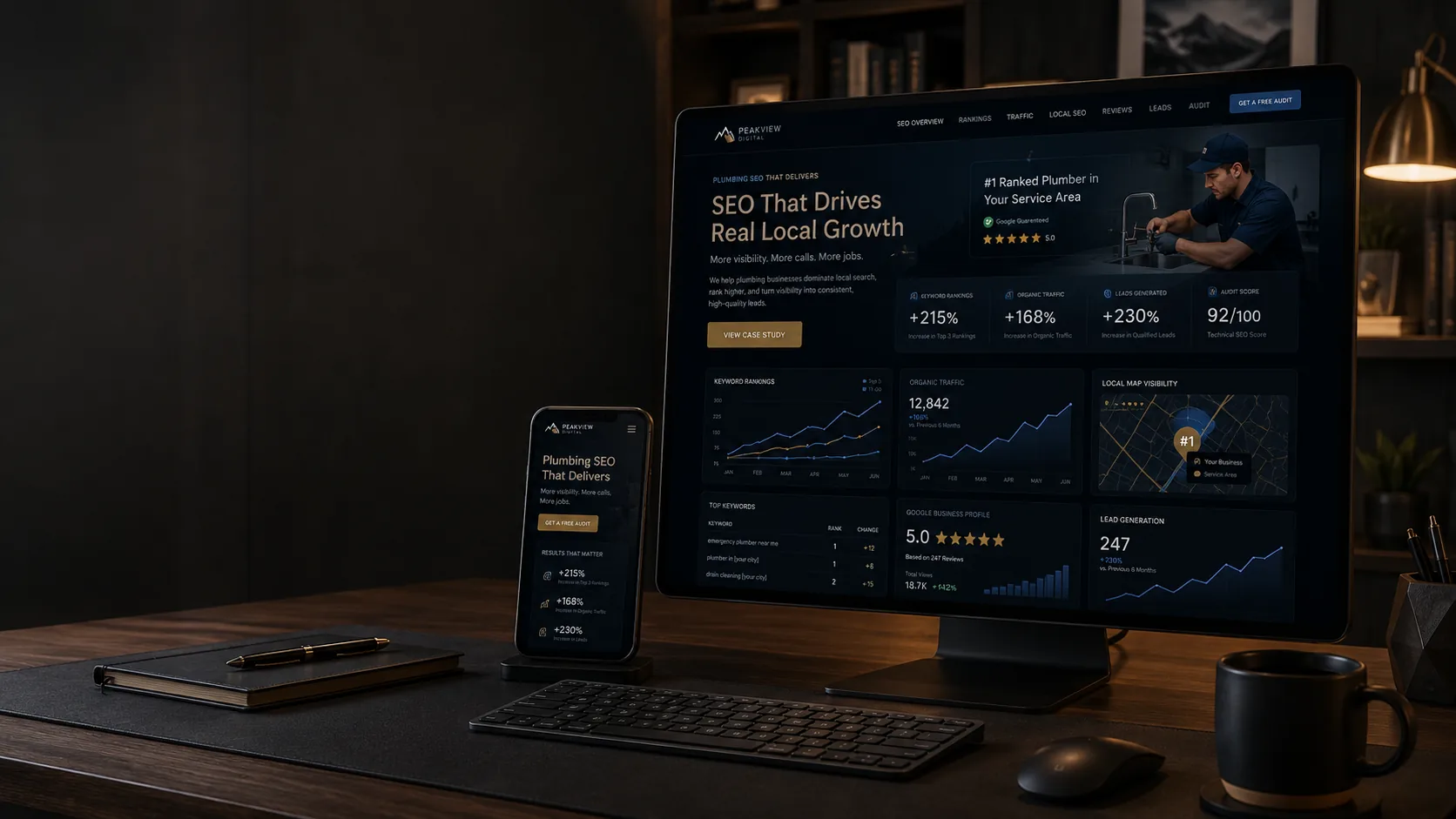
Google can understand a great deal, but it should not have to solve a riddle to identify your business. If the homepage says only “quality solutions,” services are buried in a slideshow, and every page has the same vague title, both customers and search systems receive weak evidence.
The fix is not repeating keywords. It is making the business specific.
Run the ten-second test
Open your homepage on a phone and answer four questions without using the navigation:
- What does this company do?
- Who is the service for?
- Where does the company work?
- What should a qualified visitor do next?
If the answers depend on a rotating banner, stock photo, or slogan that could describe an accountant, electrician, or software company, the message is too broad.
“Residential electrical repairs and panel upgrades for homeowners in central New Hampshire” is clear. “Powering possibilities with trusted solutions” is not.
Give important services their own evidence
A service mentioned once in a list is a claim. A useful service page explains what the service includes, who needs it, common situations, boundaries, process, proof, and next step.
That does not mean creating a page for every tiny variation. Group services when the customer’s question and buying process are substantially the same. Separate them when each deserves a distinct explanation and search intent.
For example, an electrician may need separate pages for service upgrades and generator installation because the problems, planning, proof, and questions differ. “Ceiling fan replacement” might fit naturally within a broader residential electrical service page.
Make the signals agree
Google uses many sources, but the business-controlled pieces should reinforce one another:
- A descriptive page title and one clear main heading
- Visible text that names the service in natural language
- A logical URL and navigation label
- Links from related pages using meaningful anchor text
- A Business Profile category that describes the core business
- Accurate Organization or LocalBusiness structured data that matches visible content
- An About page that identifies the company and relevant experience
- A Contact page that states location or service area and a working contact method
Structured data is supporting information, not a substitute for clear copy. Google specifically says markup should match what visitors can see.
Look for accidental ambiguity
Similar business names are not the only source of confusion. A company may use an acronym in the logo, a legal name in the footer, an old brand on Facebook, and a shortened name in Google. It may say “New England” on the homepage while serving only a portion of New Hampshire. It may use “construction” even though it performs only countertop fabrication.
Write down the plainest accurate description of the company, its main services, and its real service area. Use that description as an editorial compass, not as a block of text to copy everywhere.
Check what Google can actually reach
Important pages should be linked from another findable page with ordinary crawlable links. Text should exist in the page, not only inside images or unsupported interactive elements. Google’s developer guidance notes that crawlers follow links and may not see everything a browser displays.
Search Console’s URL Inspection tool can show whether a page is indexed and what Google retrieved. A site search such as site:example.com service name can offer clues, but it is not a complete audit or a ranking report.
Clarity is useful even without rankings
The same work that helps search systems interpret a company helps a homeowner decide whether to call it. That is the standard worth using. Do not make pages stranger for people in an attempt to explain them to a machine.
How do you know whether Google is confused?
No single test gives a complete answer, but several clues are useful together:
- Search Console shows impressions for unrelated queries while core services earn little relevant visibility.
- Google rewrites titles in ways that expose vague or duplicated headings.
- The wrong page repeatedly appears for a service search.
- The Business Profile uses a broad or inaccurate category.
- A brand search shows an old description, phone, or location.
- Customers regularly ask whether the company provides a service listed somewhere on the site.
Do not diagnose confusion from one unusual result. Location, competition, indexing, authority, and personalization can also affect what appears.
A service-clarity audit
Choose one commercially important service and trace it through the site:
- 1.Find it through the navigation using customer language.
- 2.Read only the page title, main heading, first paragraph, and section headings.
- 3.Confirm that scope, customer type, service area, and next step are explicit.
- 4.Check that related projects and articles link to it descriptively.
- 5.Compare Business Profile categories and services with the real offer.
- 6.Inspect the URL in Search Console and test structured data.
- 7.Ask an unfamiliar person to summarize the service from the page.
If their summary is wrong, improve the visible explanation before adding technical markup.
What if the business offers many unrelated services?
Do not force them into one generic “solutions” page. Organize them into customer-recognizable groups, give major services distinct pages, and show the relationship between them. If two business lines have different brands, locations, audiences, and sales processes, they may need clearer organizational separation.
For example, a company that performs electrical work and rents event equipment should not expect one paragraph to establish both offers. Separate navigation paths, page clusters, and contact expectations reduce ambiguity.
You do not need to repeat an exact phrase in every heading, add every schema property, or create a page for every synonym. Bring in technical SEO or web support when important pages are not indexed, rendering hides content, several URLs compete for the same intent, or a redesign must preserve existing search value.
Related reading
What every contractor website should include
Matching your Business Profile and website information
Sources
Google: Get started with SEO for developers
Google: Organization structured data
For a plain-language review of your website and search-presence clarity, schedule a free strategy call with TechDad Technology.